## Overview Broad acceptance of race as a *constructed* instead of *essential* social category . . . > “a socially determined construction with complex biological associations” (Holland, 2008) . . . On the one hand, so what? Economists are typically less interested in philosophical fights taking place elsewhere in the humanities . . . Race is clearly real and can't be just waved away as a "construct" . . . On the other hand, growing literature demonstrates that fluidity of these social categories matters for measurement and interpretation ## Fact one: Racial identity is fluid and contested {.facts-slide} :::: {.columns} ::: {.column width="40%"} 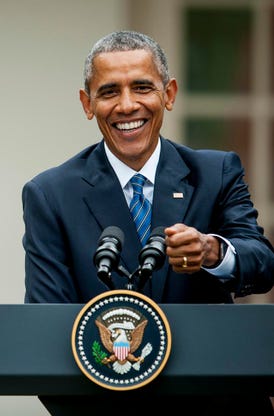{.nostretch width="75%" fig-alt="Portrait of Barack Obama"} ::: ::: {.column width="60%"} President Obama: “I identify as African-American—that's how I'm treated and that's how I'm viewed. I'm proud of it” . . . 2010 Pew Poll: 27% of Americans label Obama as Black (55% for those who identify as Black and 24% for whites) ::: {.fragment} Meaningful fraction of Americans switch racial identities over time (Liebler, 2017) ::: ::: :::: ## Fact two: Racial perceptions depend on non-racial factors {.facts-slide} :::: {.columns} ::: {.column width="40%"} 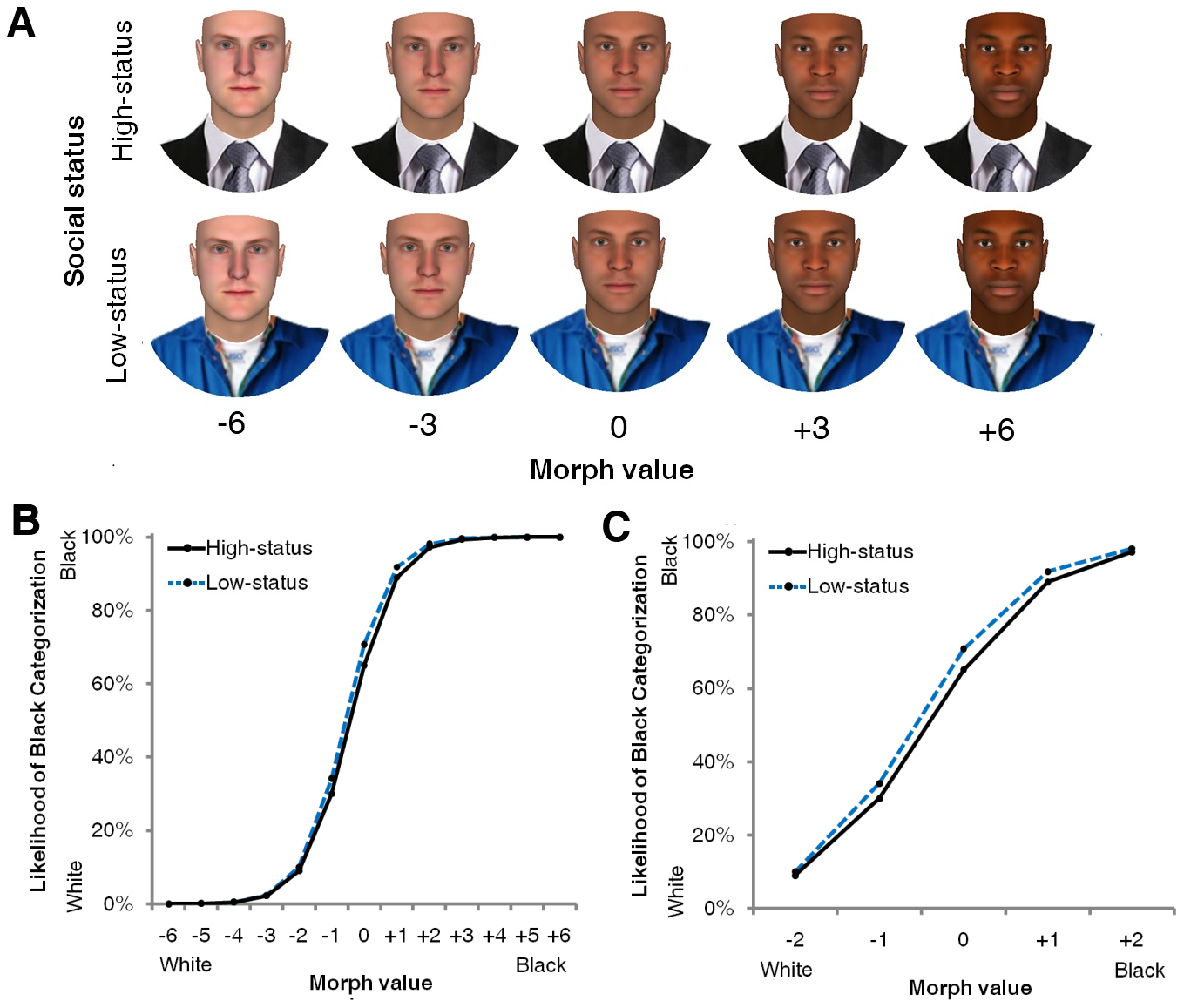{.nostretch width="100%" fig-alt="Faces in different clothing from Freeman et al. (2011)"} ::: ::: {.column width="60%"} Freeman et al. (2011): Identical faces categorized as Black more often in low-status clothes Saperstein and Penner (2012): Racial coding sensitive to history of incarceration (cf. Charles and Guryan, 2011) Gaddis (2017): Black names given by more educated mothers seen as less Black (e.g., Bria vs. Tamika) ::: {.fragment} Key point: Even if demographic labels are unchanged, observed characteristics affect how social identity is perceived (e.g., Monk Jr., 2021) ::: ::: :::: ## Fact three: Social identity is manipulable {.facts-slide .identity-slide} Individuals constantly signal social identity with a variety of actions ::: {.nonincremental} - e.g., by “whistling Vivaldi,” adopting new names and clothing, affecting patterns of speech, etc. ::: “Passing” is possible because racial identities are not strictly tied to innate physical characteristics > You are not Black because you are (in essence) Black; you are Black... because of how you act... because of how you juggle and combine many differently racialized and class(ed) actions (walking, talking, laughing, watching a movie, standing, emoting, partying) in an everyday matrix of performative possibilities (Jackson Jr., 2010) ## The econ awakening These ideas are increasingly penetrating the econosphere . . . Cornwell, Rivera, Schmutte (2017): wage changes in Brazil are associated with changes in racial categorization . . . Adukia, Hornbeck, Keniston, Lualdi (2026): wealth and literacy predict enumerator categorization conditional on skin tone in 1870 Census . . . Rose (2023): Race gaps in skin shade and distinctive speech in NLSY shrink with demographic, education, and AFQT controls, along with wage gaps . . . I view this paper as the richest empirical exploration of these ideas to date ## What do we learn? There is a lot in this paper, including a very beefy appendix! . . . What do I take away? . . . 1. Substantial mismatch between employer- and self-ascribed racial categories in Brazil, as well as across employers . . . 2. Nuanced relationship between skin tone and racial categorization, mediated by education level, cohort, and region . . . 3. Race gaps in cues (e.g., skin tone) shrink with "benchmarking" controls, complicating interpretation of residual gaps ## Lots more in the paper Some amazing facts buried in the appendix: . . . 1. In an AKM decomposition for employer-ascribed race categorization, firm FE explain 25\% of variance in race categories! Approximately the same share as worker FE. . . . ::: {style="margin-left: 2em;"} Would love to see more analysis of these firm effects, e.g., a. Connection to wage premia b. Connection to employer size and industry c. Connection to employer racial composition ::: . . . 2. Strong effects of prior wages on both employer- and self-declared race, even conditional on detailed controls . . . These labor market history variables seem like first-order inputs to the “race function,” especially when we're considering wage gaps ## Where is the room to learn more? Two areas where I would like to learn more: . . . 1. Race as continuous vs. discrete categorization 2. Endogenous inputs in the race function ## Continuous categorization Paper primarily treats racial categorization as a discretization of underlying latent perception: $$ r^q = A_q(Z) + u^q \\ R^q = 1 \{ r^q \geq \tau_q \} $$ . . . Implies that changing $Z$ changes both categorization at the margin ($Pr(R^q = 1)$) and inframarginal perceptions (distribution of $r^q \mid R^q = 1$) . . . Not obvious that people respond to discrete categories vs. how white/black someone seems . . . E.g., strong colorism gradient among people with same self- or employer-ascribed race ## Continuous categorization Perhaps we could learn more about effects of shifting cues among the inframarginal groups here . . . Allowing outcomes to depend on $r^q$ vs. $R^q$ also has obvious implications for the perception-normalized disparity (PND) . . . Analogy to IV is discretizing a continuous treatment; creates exclusion issues when instruments shift treatment along intensive margin . . . Authors are very careful to treat the PND as a measurement and not causal exercise, but I would like to see versions that attempt to normalize using differences in the distribution of $r^q$ rather than $Pr(r^q \geq \tau_q)$ ## What is the race function? Long history of race as an endogenously shaped identity (e.g., Coate and Loury, 1993; Steele, 2010; Austen-Smith and Fryer, 2005) . . . How much of the differences across self- and employer-ascribed categories, as well as changes in categorization across groups, reflects choices in how people present? . . . Obviously a hard problem, but interesting opportunities here: - Response of categories to categories of peers - Dynamics in categorization - Response of categorization to labor market conditions . . . Would bring a little more econ to the paper by thinking about the behavioral margins underlying the very interesting empirical facts ## Bottom line Impressive, interesting work . . . Incredibly detailed and credible analysis . . . Probably several more papers to write just using this merge